
Karting is completely different from driving on city roads, which are designed to be standardized, with slow curves and orderly passage of vehicles. Whereas racing cars have no speed limit and need to make full use of vehicle performance. Even if you are an experienced driver, you need to reacquaint yourself with the track. On the track, overtaking is an exciting spectacle for drivers. Overtaking is not just about speed, but positional relationships. Remember what you know from middle school physics, the formulas for distance, speed, and acceleration.
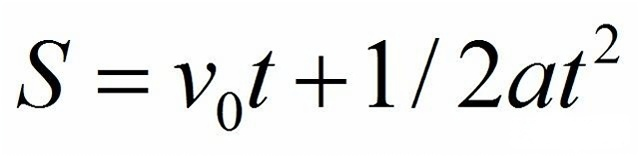
Distance = initial velocity * time + 1/2 acceleration * time^2
Kart racing uses a specified and unmodifiable engine with a minimum overall weight limit, resulting in little difference in acceleration a between cars.
Therefore, the only difference is the exit speed V0, which determines whether the distance to the car in front can be reduced.
In this case, while it may seem possible to overtake the car in front by going faster, the actual ability to overtake depends on the ability of the car behind to travel a longer distance in a given time period s. However, the limited availability of suitable overtaking zones means that this window of time is very short.
To give a counter-example:
2020 F1 Silverstone, UK, Hamilton had a flat tire and lost a lot of speed, with Verstappen in hot pursuit. Despite the big speed difference, Hamilton ended up winning narrowly. This shows that slow speed can not overtake the opponent.
Theoretically, the floor oil is ineffective, explaining the doubt of “full throttle to the end is still behind”, because of the slow speed out of the corner.
Even if the gas pedal is still on, the oversteer and small turning radius result in low exit speeds.
There is an ideal line, the racing line, and driving on that line is the way to go.
Thought experiment:
Suppose you are driving 100km/h north on an airport runway and 1km in you need to drive 100km/h south. one approach is to drive 1km north and then brake and reverse for the shortest distance.
Another approach is to approach the left side of the runway and slow down at 1km to come back in a semicircle.
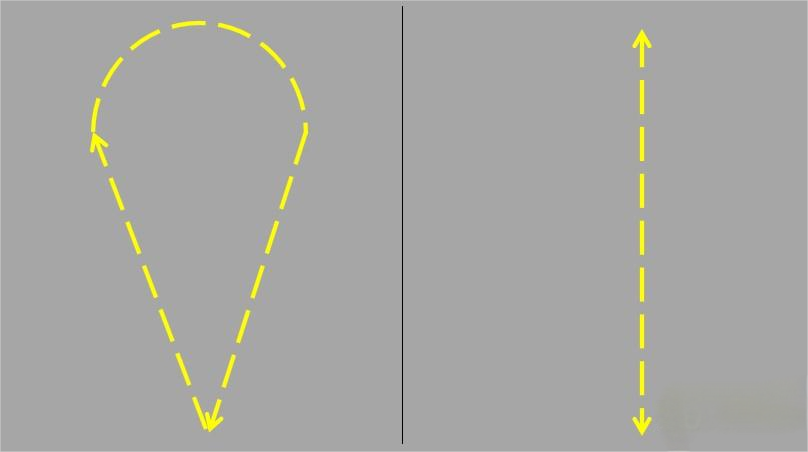
The drawn circle route is faster out of the turn and is a better choice for those seeking to exit the turn quickly.
The circular route utilizes the linear velocity and centripetal force of the circle, with no loss of speed.
A straight line path requires deceleration and acceleration, and the opponent can use this time to return to the route quickly by moving in a circular motion.
Quantitative calculations can be performed by interested parties. When the radius of the arc is moderate, the calculations usually support the drawn circle line.
Experiments have shown that although the race line is not the shortest, it is the fastest line and should be followed to increase speed.