
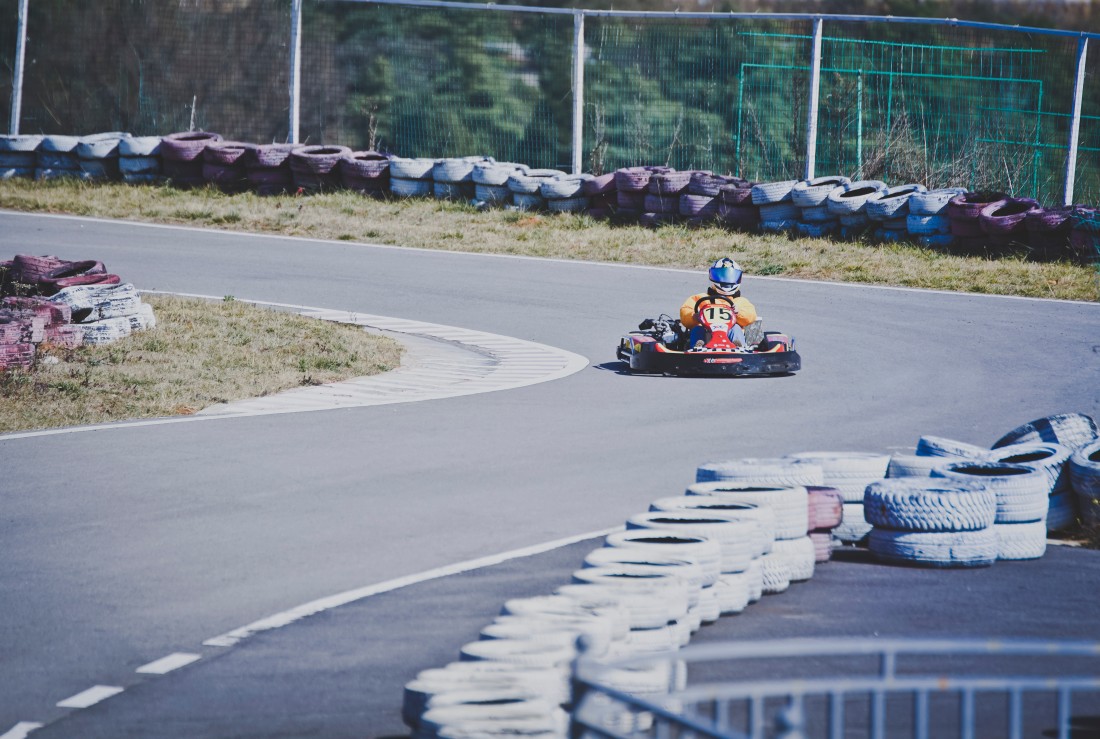
Recreational karting tracks typically contain U-shaped, S-shaped and high-speed corners. The width and length of the track, the characteristics of the straights and curves, and the way they are combined vary, so choosing the right line is crucial.
Next, we will briefly discuss the driving techniques and considerations for the three types of corners.
High-speed curves: Stay as close to the outside as possible before entering the curve, aim at the center of the curve, and pass close to the center of the curve. Give fuel before and after the center of the corner. Some high-speed curves even allow full-throttle passing.
U-turns: also known as hairpin turns, whether you take the late braking to focus on the speed of the turn (large angle of entry, small angle of exit) or early braking to focus on the speed of the turn (small angle of entry, large angle of exit) are possible. The important thing is to control the body attitude, pay attention to the brake throttle coordination. Otherwise, you will understeer or oversteer.
S-curve: In S-curve, try to maintain a constant speed, to pass in a close to straight line, before entering the curve to reduce to the appropriate speed, loose oil through the center of the curve, can not blindly refueling and stepping on the brakes, otherwise it will be in the curve to lose balance, affecting the line and out of the curve speed.
We take the difficult to master U-bend as an example, to share a common cornering skills.
1、Keep the direction stable when decelerating and braking to avoid skidding and affecting the cornering time.
2、Gradually increase the throttle when leaving the corner to prevent oversteer and affect the lap time.
3、Grip driving is the use of tires and ground friction, smooth cornering.
4、Sliding driving involves braking, throttle and steering coordination to achieve drifting, but will lose power and wear tires.
5、Head turns with the steering wheel when cornering, using the body's center of gravity to reduce centrifugal force.