

Frame
The kart chassis is made of chrome molybdenum tubing and is a suspension-less design that needs to be flexible and strong in order to function as a replacement for the suspension and to ensure that it will not break during cornering. In the United States, go-kart chassis are categorized as “open”, “caged”, “straight” or “offset”. The chassis types recognized by the International Karting Council are “straight” and “open”.
Open karts have no roll cage. Cage karts are equipped with a roll cage that surrounds the driver and are suitable for dirt tracks. Straight chassis center the driver and are designed for sprint car racing. An offset chassis places the driver on the left side and is used for racing on left-turn tracks.
Kart chassis stiffness affects handling characteristics, with a stiff chassis for dry conditions and a soft chassis for wet conditions. Track temperature variations may require chassis adjustments. The optimum chassis can be adjusted with reinforcing bars. Regular karts have disc brakes on the rear axle. Front disc brakes are common in transmission karts, but are prohibited in some categories. Transmission karts have adjustable dual master cylinders. Professional karts weigh 75 to 79 kilograms empty.
Engine
Karts are usually powered by four-stroke or electric motors, while competition karts tend to have small two-stroke or four-stroke engines. Four-stroke engines generally range from 5 to 20 horsepower and are suitable for different types of karts. More powerful four-stroke engines, two-stroke engines are mostly used in professional races, and 250cc engines can be over 90 horsepower.
Transmission
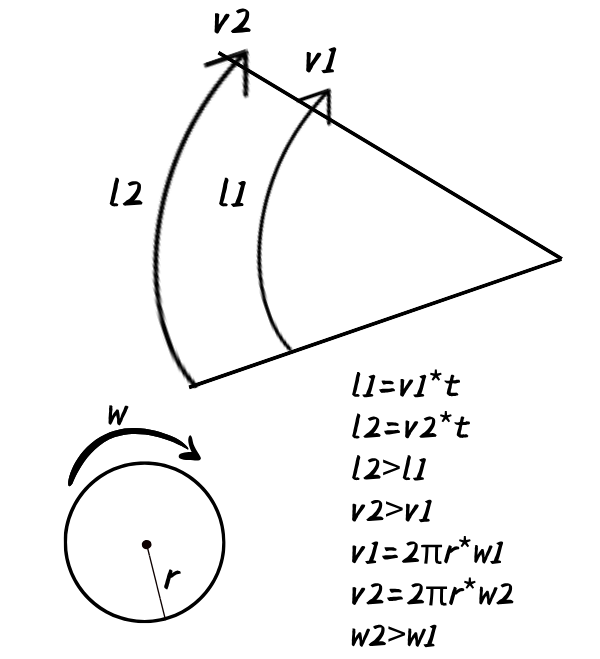
As shown in the diagram, the outside tire speed w2 is higher than the inside tire speed w1, so vehicles usually use a differential to achieve smooth cornering. However, karts do not have differentials due to cost and usage constraints, resulting in one of the rear tires having to slide when turning. This is achieved by design, where the inside rear tire lifts slightly during a turn, reducing grip or even sliding or coming off the ground.
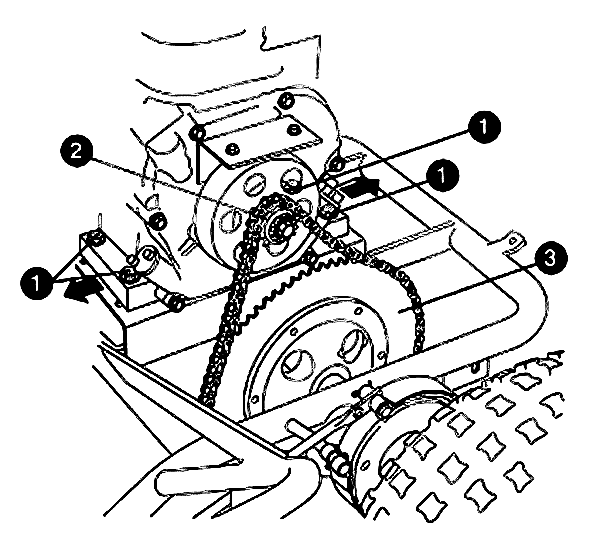
Power is transmitted to the rear axle via a chain, and the engine and sprocket are removable and need to be scaled to the track to maximize power output. Initially, karts used direct drive, but this was soon replaced by the more convenient centrifugal clutch. Today, dry centrifugal clutches are widely used in a number of karting categories, and 125cc clutch engines have become commonplace in top international race cars.
Tires
Kart tires are small, with rims made of lightweight metal or composite materials. They can withstand cornering forces in excess of 2g, depending on the vehicle setup.
Kart tires come in a variety of types to suit different track conditions: soft to hard tires for dry tracks, with the softest commonly used in international racing; rain tires with grooves for wet tracks; and spiked tires or grooved tires designed for dirt tracks for special conditions. Tire pressures also vary between cold and hot, usually around, cold: 8-13 psi; hot: 10-14 psi. kart tires are usually around 11” in size.
Data Acquisition
Kart racing utilizes a variety of data acquisition systems that allow drivers to view key parameters such as RPM, lap times, lap times, optimal lap times, cooling and exhaust gas temperatures via a display on the steering wheel. Advanced systems record sensor data to support race replay and data download to analysis software. More sophisticated systems process more data, including acceleration, throttle, steering wheel position and brake pressure.